

Government extends KAYO model “tentacles” to healthcare with new “MedAL” company
This article was translated automatically from the Albanian original. 🇦🇱 Lexo në shqip
Partnerships with private firms and state property at stake
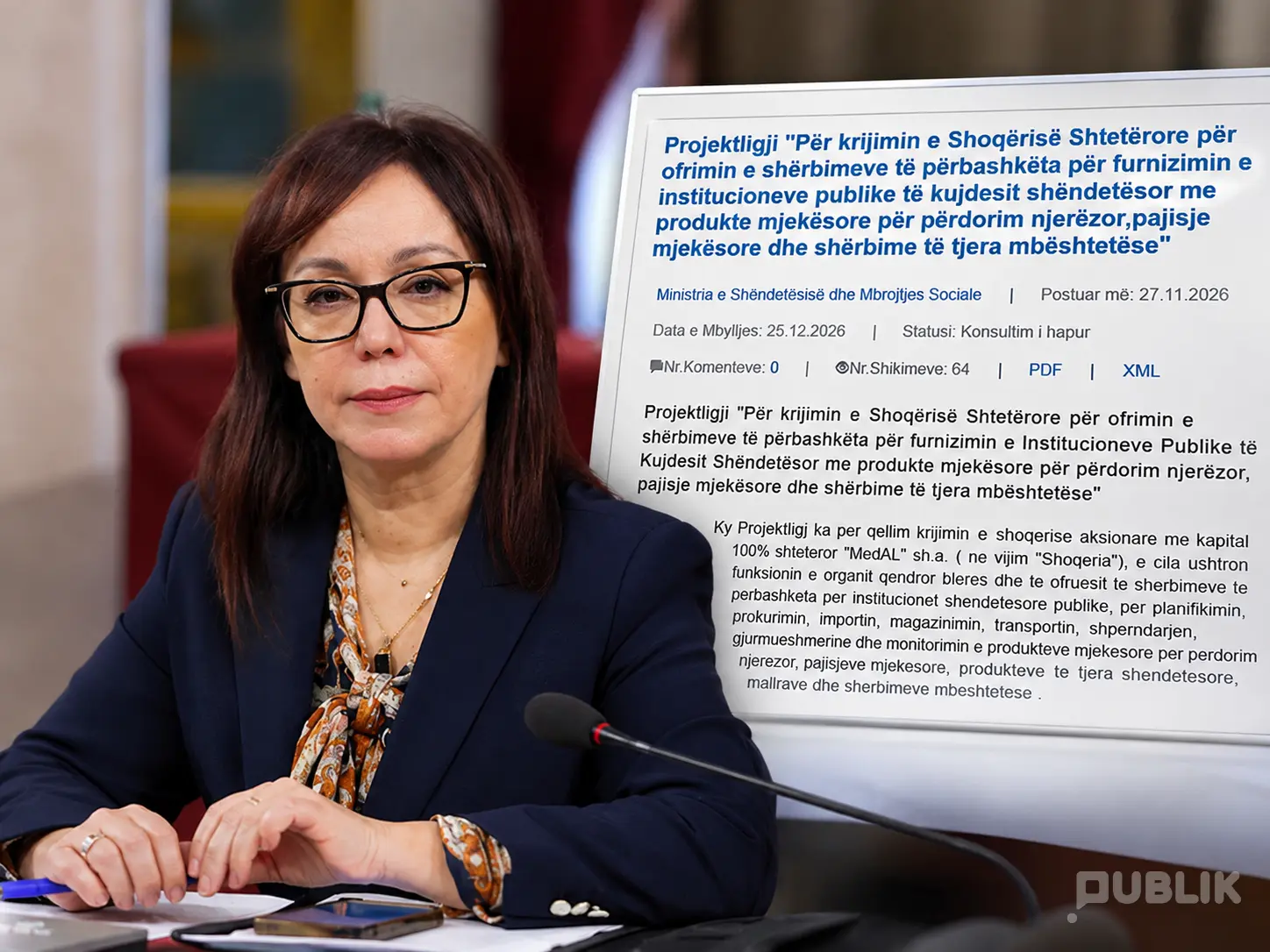
Following the model of the state-owned company KAYO in the defence industry, the government is preparing a similar structure in the health sector. The draft law on the creation of “MedAL” sh.a. provides not only for supplying hospitals with medicines and medical devices, but also for the possibility of creating joint companies with private business, buying shares and using state property as capital. The Ministry of Health has formalised another initiative that is expected to open debate on how public funds will be administered in the pharmaceutical sector. On 27 November, the institution published the draft law on the creation of the joint-stock company “MedAL” for public consultation. According to the proposal, the company would be 100% owned by the state and would have as its mission the supply of public hospitals with medicines and medical devices.
The government presents the initiative as a mechanism to guarantee the continuous supply of hospitals and to prevent repeated shortages of medicines. However, beyond this objective, the powers envisaged in the draft law go considerably further than organising public procurement. At the centre of the debate are the opportunities the new company would have to enter commercial relations with private companies, to create joint business structures and to include state assets in these agreements.
“MedAL” may become a partner with private medicine companies
Articles 4 and 6 of the draft law provide that “MedAL” sh.a. would have the right to create joint companies with private entities, as well as to buy shares in companies engaged in the production or trade of pharmaceutical products. Another important element is the possibility of using state property as a contribution to the capital of these companies. In other words, public assets could be included in economic structures in which the state would cooperate directly with private interests.
Concerns also grow over how these partnerships could be created. According to the draft, the process may also be initiated by unsolicited proposals from private companies themselves. Meanwhile, part of the information related to the agreements may be treated as a trade secret. This raises several essential questions: Who will select the companies that become partners of the state? How will the value of public properties that may be used as capital be determined? What mechanisms will guarantee transparency and control over these agreements?
This concerns a sector through which considerable public funds circulate and where every decision directly affects the supply of hospitals and the treatment of patients.
From the defence industry to health, the KAYO model is repeated
The similarities with the state company KAYO, created in 2024 for the defence industry, are one of the most debated aspects of the initiative. The proposed legal structure for “MedAL” contains mechanisms similar to those envisaged for KAYO, particularly regarding the creation of joint ventures with private business and the possibility of including state assets in these collaborations. Critics of this model argue that through KAYO a mechanism was created in which public assets and taxpayer-funded contracts can be included in joint structures with private entities. Now, a similar logic is proposed to be extended to the pharmaceutical market.
The difference is that this time the sector is vital: in addition to the administration of public property and funds, the discussion also concerns the supply of medicines to citizens who receive services in state hospitals.
Denmark and Portugal as models, but with a key difference
In the accompanying report to the draft law, the government cites as references the Amgros agency in Denmark and the SPMS structure in Portugal. Both institutions are models for organising public procurement in the health sector, where the aim is to secure products and services on the most favourable terms and prices through competitive procedures. However, the comparison raises questions, because according to critics of the project, these European models do not provide for the same logic of commercial partnerships between the public purchaser and the companies that supply the market with medicines.
This is the main difference: an institution that organises open procedures and selects suppliers through competition has a different role from a state company that may simultaneously become a shareholder in private businesses in the pharmaceutical sector. In the second case, there is a risk that the state’s role as guarantor of competition and administrator of public funds becomes intertwined with the economic interests of its private partners.
The state’s veto does not answer all the questions
The draft law provides for some guarantees, among them the state’s right of veto and restrictions on using funds intended for purchasing medicines to cover the losses of the partnerships. However, these provisions do not automatically answer concerns about possible conflicts of interest, the transparency of agreements and the control over the use of public assets.
If “MedAL” is to play a central role in supplying hospitals while also being part of companies that produce or sell medicines, there is a need for very clear mechanisms that guarantee the separation of public interest from commercial interest. Otherwise, the concentration of purchases and the creation of direct relations with suppliers could restrict competition and affect how public contracts are distributed.
Albanian healthcare faces low funding, while citizens pay out of pocket
This whole initiative comes at a time when the Albanian health system faces ongoing funding problems and high costs for patients. According to data presented in analyses of the project, Albania spends around 326 euros per person a year on healthcare, roughly 11 times less than the European Union average. Meanwhile, around 60% of total healthcare expenditure is paid directly by citizens. This means that a considerable part of the financial burden of treating illness remains on Albanian families.
In these conditions, the creation of a new company does not in itself guarantee cheaper medicines, better supply or higher-quality service. The outcome will depend on how the company will operate, how purchasing procedures will be carried out and what control will be exercised over relations with the private sector.
Klodiana Spahiu takes over the project after Evis Sala’s departure
Another element accompanying this initiative is the change in leadership of the Ministry of Health. Klodiana Spahiu was appointed minister in September 2026, after the early departure of Evis Sala. According to reports published earlier, the project to create this structure had been discussed since the summer months and had caused opposition at the government’s leadership levels. Former minister Evis Sala reportedly refused to sign the initiative, while her successor has now taken the project forward by publishing it for public consultation. This places Klodiana Spahiu at the centre of one of the most important initiatives for reorganising the medicine supply market in the country.
In conclusion, the key question remains whether “MedAL” will be an instrument for resolving medicine shortages in public hospitals, or whether it will create a new mechanism for concentrating funds and contracts in structures where the state and private business become partners. After the defence industry, the KAYO model is now being proposed for healthcare too. But this time, beyond public assets and taxpayers’ money, what is at stake is an interest that directly affects every citizen: their health and their life.
“