

Nov. 28 Protest Crosses Borders as International Media Echo Albanians’ Anger
This article was translated automatically from the Albanian original. 🇦🇱 Lexo në shqip
From American news agencies to British broadcasters, and from Italian, Greek, Brazilian and Middle Eastern media, the demonstration against the Rama government has become an international story. Reuters, AP, AFP, Bloomberg, The Guardian and Al Jazeera are covering the developments, the clashes and the demands of the protesters. The protest held on 28 November in Tirana, on the day Albania celebrated the 114th anniversary of its Independence, has drawn the attention of many international media outlets. Developments in the Albanian capital have crossed the boundaries of regional reporting, being covered by major news agencies, prestigious television channels and news portals on several continents. Reuters, Associated Press, Agence France-Presse (AFP), Bloomberg, The Guardian, The Washington Post, Sky News, Euronews and Al Jazeera are among the media that have reported on the demonstration, the demands for the removal of Prime Minister Edi Rama and the recorded tensions between protesters and police. The coverage has also reached Italy, Greece, Brazil, Singapore, Namibia, New Zealand and countries in the Middle East. Such a wide spread of reporting has placed the Albanian protest in the attention of the international public, precisely on one of the most symbolic dates in the national history. The focus of the reporting has not been only on images of clashes in the streets of Tirana. Foreign media have also addressed the dissatisfaction that has fuelled the civic mobilisation, the involvement of students and the diaspora, accusations of corruption, economic difficulties and demands for political change.
Reuters: Protests are becoming a serious challenge for the Rama government
The international agency Reuters has placed the 28 November demonstration in the sequence of protests that have engulfed Albania in recent months. In the reporting by journalist Fatos Bytyçi, it is emphasised that the mobilisation against the government represents one of the most significant political challenges faced by Edi Rama since he came to power in 2013. Reuters dwells on the factors that have fed civic dissatisfaction, citing the perception of corruption at high levels of government, the lack of employment opportunities and problems in the education system. Another highlighted element is the message of protesters through the banner “Albania is not for sale”. This call is linked to opposition to tourism projects on the coast, but also to wider dissatisfaction with the way the country is governed. The agency also reports the position of the Albanian government, which has denied the corruption allegations and called for dialogue. The report also mentions economic measures taken by the executive, including interventions on fuel prices and support for families in need.
Associated Press and The Washington Post: The voices of students, citizens and the diaspora
Another important report comes from the American agency Associated Press, whose coverage was also published by The Washington Post. Journalist Zana Cimili highlights the participation of citizens who travelled from various cities in Albania, as well as from abroad, to join the protest in Tirana. The article reflects citizens’ concerns about the economic situation, the lack of trust in political representation and the outlook for the young generation. Among those interviewed is 33-year-old Arian Lleshi, who had come from the United Kingdom specifically to take part in the demonstration. He expresses his dissatisfaction with the political class and the need for a generational change in the leadership of the country. AP also conveys the concerns of pensioner Suzana Gjeta, who speaks about the economic hardships faced by pensioners and the uncertainty about the future of young people. Through these testimonies, the American agency presents the protest as an expression of accumulated social discontent, beyond the clashes recorded on the streets.
AFP and Al Jazeera bring attention back to the “Flamingo” movement
Developments in Tirana have also been covered by Agence France-Presse, while Al Jazeera has addressed the origin and expansion of the protest movement in a more extensive article, referring to reports from international agencies. This coverage recalls the “Flamingo Revolution”, the movement that began in May 2026, initially as opposition to a luxury tourism project in a coastal area of particular natural importance, linked to the family of US President Donald Trump. Over time, the protest went beyond its initial environmental cause. Students, citizens and various social groups joined the mobilisation, broadening its demands to include the fight against corruption, improvements in education and healthcare, and better opportunities for young people.
AFP’s report was also distributed by NAMPA, the national news agency of Namibia, bringing the Albanian developments to coverage on the African continent.
The Guardian and Sky News focus on the clashes in Tirana
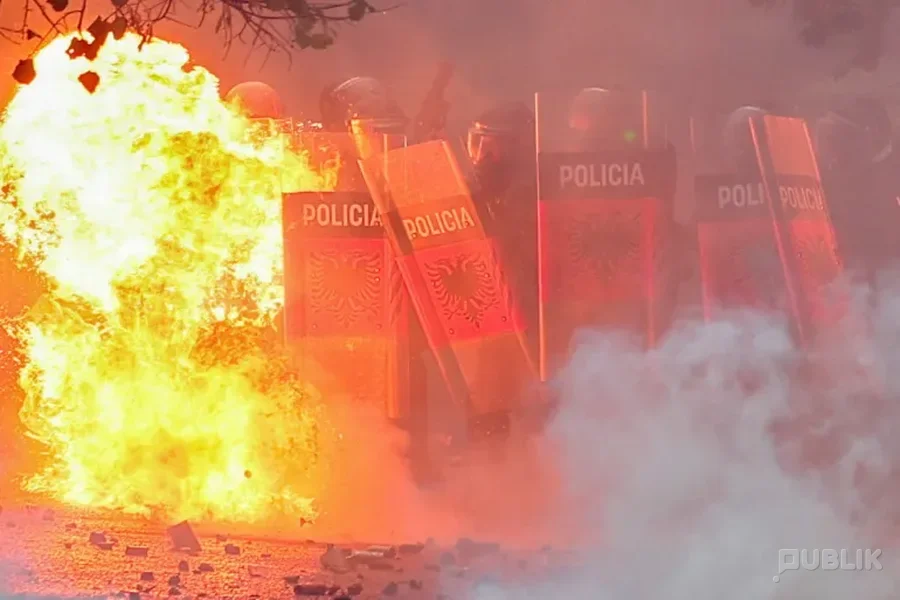
The British media outlets The Guardian and Sky News chose to put the images and developments during the demonstration in the foreground. The Guardian published a video report on anti-government protesters and the throwing of fireworks towards police, documenting the tense atmosphere in the capital. Sky News, for its part, focused on the main political demand of the demonstrators: the removal of Prime Minister Edi Rama. Images from the streets of Tirana were the central element of both reports, conveying to the British audience the level of tension during the protest on Independence Day.
Bloomberg: Escalation of demonstrations against the government
Bloomberg, one of the best-known American media outlets in the fields of economics, finance and international politics, has also devoted space to the protest in Albania. In a piece titled “Anti-Government Protests Turn Violent in Albanian Capital”, the agency highlights the escalation of the situation and the clashes between demonstrators and security forces. The presence of Albanian developments in a media outlet of this profile is another indication of the interest the political situation in the country has attracted, going beyond the attention of media that cover current affairs in the region.
Euronews: Students and Albanians abroad united by the same cause
The pan-European broadcaster Euronews covered the protest through an article by journalist Gael Camba, paying particular attention to the mobilisation of students and citizens from the diaspora. The report also includes the testimony of student Juna Vasili, who expresses dissatisfaction with living conditions and calls for changes in the political system. Euronews recalls that the protest movement has changed in scale over recent months. What began as opposition to a coastal project has turned into a mobilisation with demands that include education, economic conditions and the accountability of institutions.
Italian press highlights opposition to Rama and Berisha
International coverage has not been limited to English-language media. In Italy, developments in Albania have been covered by the magazine Internazionale and the news agency Agenzia Nova. Internazionale published Reuters’ report on the demonstration, the participation of students and the clashes with police, in both Italian and English. Agenzia Nova highlighted a political aspect of the protest: the opposition that some demonstrators express towards the two main figures of Albanian politics, Edi Rama and Sali Berisha. The report also quotes protesters’ slogans, including “Albania is not for sale!” and “Rama in prison, Berisha in prison!”. The Italian agency also reported that the organisers aim to continue the mobilisation on 29 November, Liberation Day.
Kathimerini brings the protest to Greek readers
The Greek newspaper Kathimerini devoted space to the demonstration in Tirana by publishing the Associated Press report in the English-language edition of its international section. The focus is on the participation of Albanians from the diaspora, the demands of students and dissatisfaction with traditional political parties. The article also highlights the link between the mobilisation of recent months and opposition to the tourism project on Albania’s southern coast.
From Brazil to Singapore, the Albanian story travels to other continents
Attention to the protest has also reached Latin America. The Brazilian portal UOL (Universo Online), one of the largest news platforms in the country, published an article on the student demonstration against the Albanian government and its conclusion with clashes. The report focuses on economic dissatisfaction, demands for better university conditions, lower tuition fees and increased financial support for students. UOL also recalls that Edi Rama has headed the government since 2013 and that he has rejected demands for his resignation. Meanwhile, in Asia, the Singapore-based newspaper Lianhe Zaobao reported on the tensions and clashes during the 28 November protest. In the Middle East, Al Arabiya published an account of the clashes between police and anti-government protesters. Audiences in Oceania have also been informed of developments in Albania, as Yahoo News in its New Zealand edition distributed Reuters’ expanded report.
The Jared Kushner project, a theme that recurs in foreign reporting
One issue that recurs in a considerable share of international articles is the tourism project linked to Jared Kushner, son-in-law of US President Donald Trump. Foreign media identify opposition to this project as one of the factors that triggered the protests launched in May 2026. However, in the following months, the movement’s demands expanded considerably. Environmental concerns and the protection of the coastline became intertwined with concerns about corruption, the functioning of institutions and the economic situation of citizens. Reuters’ report also conveys the position of Prime Minister Rama, who defended the legality of the project and stated that natural habitats will be protected.
Use of force by police and European integration
Another theme that has drawn the attention of international media is the way the protest was handled by the security forces. According to reports, the demonstration began peacefully, but the situation later became tense. Police used tear gas and water cannons, while on the protesters’ side, stone and petrol-bottle throwing was reported. Al Jazeera, citing the toll released by the Ministry of Health, reports that people were injured, among them police officers and journalists. The outlet also notes calls from the European Union for an investigation into possible excessive use of force by police and for a de-escalation of tensions. This issue carries particular weight at a time when Albania aims to complete its European integration process by 2030. Respect for the right to protest, the proportionality of police interventions and the functioning of democratic institutions remain under the observation of international partners.
28 November, from Independence Day to a protest with international resonance
The coverage of the demonstration in so many media outlets highlights several of the themes that have accompanied the civic movement in recent months: dissatisfaction with governance, accusations of corruption, economic hardship, problems in education, the participation of students and the engagement of the diaspora. While some media have focused on the clashes and images from the capital’s streets, news agencies have also brought testimonies from citizens and the political and social context of the protests. The fact that the developments of 28 November have been reported by media in North America, Europe, Latin America, Asia, Africa and Oceania shows that the protest has attracted interest beyond Albania’s borders. On the 114th anniversary of Independence, Tirana was in the international spotlight not only for the festive ceremonies, but also for a demonstration that, after several months of mobilisation, has taken on significant political and social proportions.